“Proton Conducting Ceramics: Where Do We Want to Go - and What Could Stop Us?“ PEPPER joins the discussion at SSPC22
Published: 26. November 2025
The 22nd International Conference on Solid-State Proton Conductors (SSPC22), hosted by the Technical University of Denmark (DTU - Spicing Up Hydrogen Innovation) from 14–19 September 2025, provided an opportunity for researchers from around the world to meet and exchange insights on the latest advances in proton and related ion conduction in solids.
Proton-conducting ceramics (PCC) – an emerging technology at the heart of the next generation of hydrogen production systems – was one of the key topics discussed. In this context, an international panel titled “Proton Conducting Ceramics: Where Do We Want to Go - and What Could Stop Us?” was featured at the conference.
Representing PEPPER, Dr. Rémi Costa (DLR - Spicing Up Hydrogen Innovation) joined the panel alongside representatives from major EU-funded projects, including HY-SPIRE, SINGLE, PROTOSTACK, and SUSTAINCELL.
The panel discussion explored the future direction of PCC technologies, looking towards potential application areas, while also addressing the challenges that currently limit large-scale deployment. It was agreed that although the potential of PCC is clear, the technology remains at an early stage of development, and scaling up would require substantial investments to establish a specialized supply chain – a step that could be considered quite risky at the present time.
During the discussion, it was emphasized that the first step to accelerate development and scale-up should be to focus on niche markets (including, for example, space applications) where PCC can clearly demonstrate its unique strengths. This would pull the technology development before moving towards mass-market deployment.
Aiming at technology development and
scale-up, follow-up priorities for the PCC community towards technology
development could be:
1️⃣ Demonstrate
that the technology can be manufactured reliably,
2️⃣ Prove that it
can operate stably over significant periods of time, and
3️⃣ Achieve high
performance under realistic operating conditions.
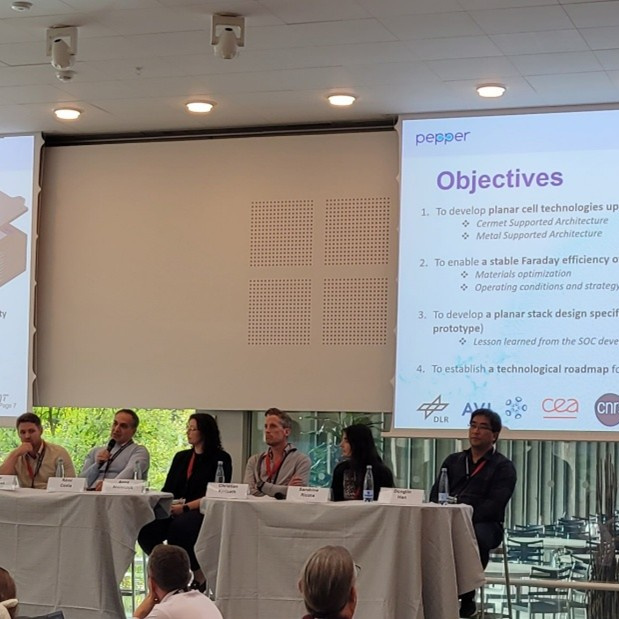
Dr. Rémi Costa introducing PEPPER at the panel discussion.

The project is supported by the Clean Hydrogen Partnership and its members.

Co-funded by the European Union. Views and opinions expressed are however those of the authors only and do not necessarily reflect those of the European Union or Clean Hydrogen Partnership. Neither the European Union nor the granting authority can be held responsible for them.